Act 1 | Setup
We built the MVP right. Then got a 6 - NPS.
Before this phase, I was the UI/UX Designer on the initial launch, building the interface to bring Halato Agency to market, for around 3 months. Then got the product shipped.
What launch revealed
We got NPS of 6. Agents weren't recommending the platform.
"If these agents already work with us, why didn't the product earn their trust yet?"
So I went to investigate, I use this process with my team
Double diamond
Act 2 | Discover
Vietnamese agents won't open up to a survey
So I needed a research method that would get honest answers from people who don't give them to strangers with clipboards.
I went with User Interviews, both offline (coffee chats) and online (call schedules). With the support from Halato members.

conversations with Agents, over call & coffee chats.
Act 2 | Discover - The trust curve
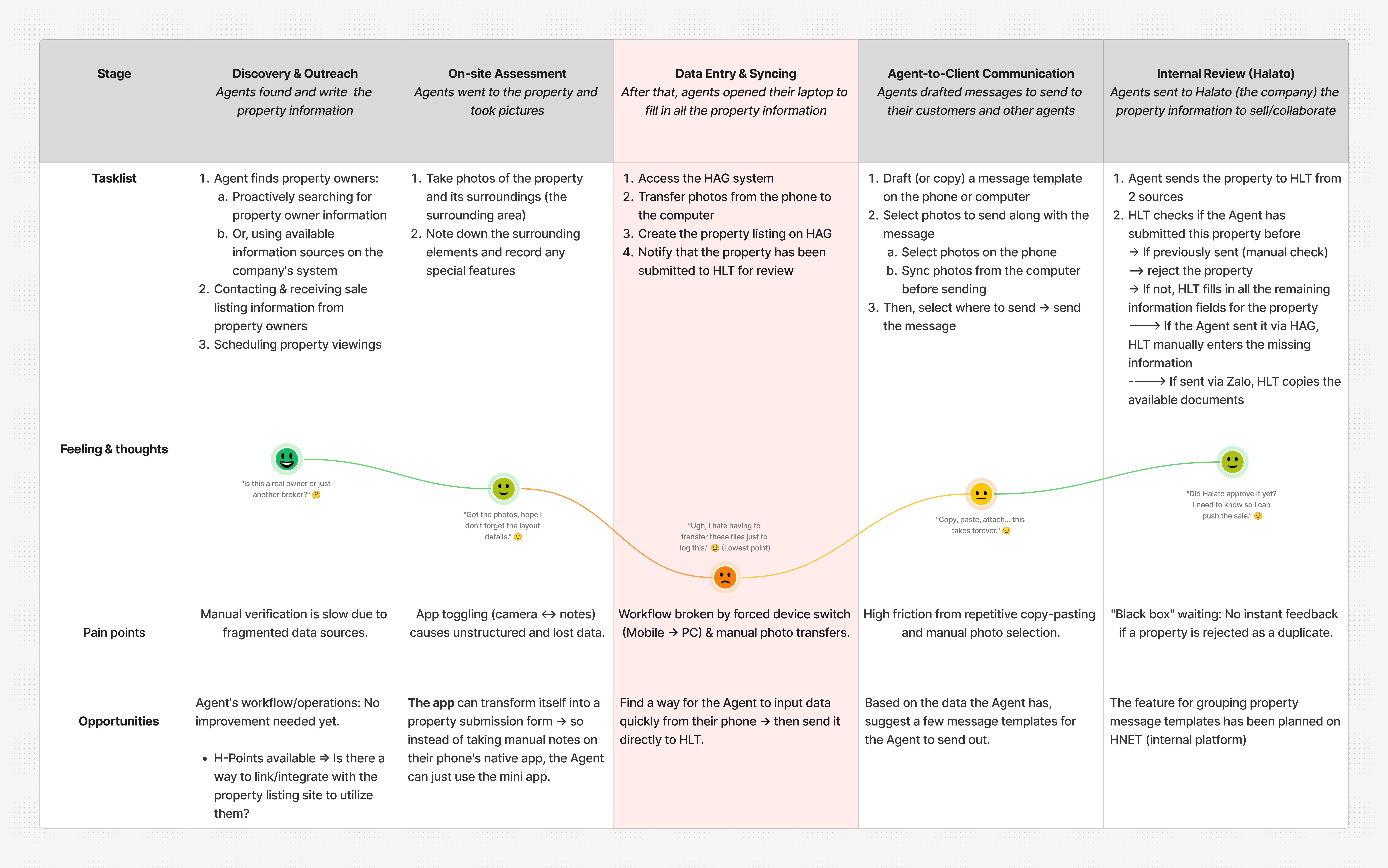
One artifact answered the NPS question
The Trust Curve - User Journey
From conversations, I mapped the agent's full property-submission journey and tracked emotion at each step. This might be where the 6 came from — and where the fix had to go.
Act 2 | Discover - Personas
Agent Personas
From the contextual inquiry research, I mapped out 3 agent personas, identified their behaviors and problems.
Hi-tech savvy freelancer - Want full control

Company Agent - Work inside the org workflow

The phone-first agent - Work very long times in the industry

Act 3 | Define - What research found
Patterns found from 30+ conversations.
With our teams
I ran internal workshops using affinity mapping to cluster the raw findings and bring the team, engineers, PM, BA to the same conclusions, since I was the only designer on the team. However, having the team here was so great to support filter all the findings found.

Act 3 | Define - Problems, problems?
Six problems. Three we decided to act on.
Affinity mapping with the full team, we turned research conversations into a shared view. Six clusters came out of it.
01
No mobile-first experience.
The job is on the street; the platform assumed a desk. Laptop input broke workflow momentum mid-deal.
02
The platform competed with Zalo instead of working alongside it.
Agents already had a working system with other, so HAG felt like extra steps on top of something that already closed deals.
03
No reliable way to price a property on the spot.
Agents were guessing in front of clients. A wrong number costs a deal.
04
Created fragmentation
Agents switched between 3–4 apps to complete one workflow. HAG was one more tab, not a consolidator.
05
No single property record system.
Data scattered across Zalo threads, phone folders, Sheets.
06
Agents feared submitting real listings - another agent could steal the deal.
They wouldn't put real data into a platform they didn't trust.
You might notice, eh, why did she chose 3 problems out of 6? Yes, this answered. We did the prioritization mapping.

Act 4 | Develop - Open Ideation Workshop
The prioritization, with the whole team behind it


With the time constraints made the scope tight, so we committed to the two things that would move the needle most, after the workshop.
Price Evaluation
Built together with the Land Evaluation Department. Real evaluation logic, connected to MAP data agents already entered.
And send to Halato for more precise price evaluation.
Build Zalo Mini App
A lightweight remote for HAG desktop. Agents submit property info on mobile, it goes straight into the system.
Act 4 | Develop - Price Evaluation tool
Develop the Price Evaluation with Halato.
I worked with Halato's Land Evaluation Department to build this tool. Halato's edge in the market is their evaluation expertise, this put it directly in agents' hands. Before any screen was designed, I mapped three entry paths. Due to NDA constraints, this is a representative snapshot.

Act 4 | Develop - Zalo Mini App
The remote for HAG desktop - Zalo Mini App
Zalo Mini App - three screens: quick create, property list, account. Agents submit a property from their phone, it lands in HAG desktop directly."

Act 5 | Design
Valuation is reachable from wherever the agent already is.
Agents reach evaluation from the main menu and from any property already in their list.

Act 5 | Design
Price Evaluation Tool
Before sending to Halato Group for more trust price, users can use Price Evaluation Tool that exclusively built by Halatop Group - snapshot from the tool

Act 5 | Design
Zalo mini app as HAG remote
Now agents can send their properties wherever they are.


Some thoughtful learnings
What I'd carry into the next project
Research before launch tells you who. Research after launch tells you where it hurts.
Structured interviews gave me three personas. Contextual inquiry three months later gave me the one moment costing trust. I'd now plan for both from the start, instead of treating post-launch research as a rescue.
A feature is only as good as the moment it's reachable from
Price Evaluation as a standalone page is a calculator. Price Evaluation inside MAP, on the property record, and inside Zalo is something an agent uses while a client is standing in front of them. Same feature, three entry points, completely different value.
Match the research method to what you actually need to know
A survey would have told me agents were somewhat satisfied. Sitting with them told me where the curve dropped. Different method, completely different finding.
Ownership is earned by the work, not the title
The Zalo Mini App decision was unpopular before it was right. Making that call - and owning the outcome - is what the Product Owner role actually required. The title just made it official.
Over 10 months I contributed to additional platform features not shown here. Happy to walk through those..
