Context
A lean experiment with one question to answer
Kyons had already built for the Vietnamese learner through a math education platform.
In late 2024, our manager handed us a challenge: test whether KyoAI could go anywhere, with given Google API credits and a tight deadline.
This was a new direction
an AI-powered workspace built specifically for how Vietnamese users study and work.
With one question…
Is there a real market here?
Our process
Lean UX
adapted for a 3-person, 4-week sprint
01
Hypothesis
02
Test hypothesis
03
Reframe
04
MVP
05
Measure
Market Reality - Our assumptions
High adoption. Low value. A wide open gap.
According to Digital Education Council Global AI Student Survey, insights from over 3,800 students across 16 countries on AI usage, expectations, and concerns to guide university decision-making.
using AI in education
with
of them using AI on a weekly basis
Despite their high rates of AI usage
1 in 2
students don't feel AI ready.
say they lack the knowledge and skills.
Zooming back to Vietnam.
Vietnam's AI adoption in 2024 wasn't gradual.
It was a wave.
of university students in Ha Noi were already using ChatGPT
Compared the numbers we had in global with Vietnam's AI adoption, pointed to one question:
why were so many students using AI, but so few getting anything meaningful out of it?
That's what we set out to find out.
Did Vietnamese have any different than the world?
Our initial thought
"The global gap likely exists in Vietnam too. If we build a structured workspace with purpose and context built in, they'll use it over a generic chat. That's the bet."
Testing our assumptions.
I designed the research goals and questions for 3 focus group sessions — 12 participants across three distinct groups. The mix was deliberate: if the same problems showed up in all three, we had real signal. If they didn't, we needed to know that before building anything.
Full session findings and theme clustering documented in Figjam!

Inductive Thematic Analy sis
Coded observations across all 3 groups to find signals, patterns that appeared regardless of who we talked to.
Observed
Not observed

Strongest Signal
"Bad prompts → bad results" and "Output feels untrustworthy" appeared across all 3 groups
The pattern was the same across every group
Group 1 - Viet Students
"I don't know how to give it the right commands — so I'm never satisfied with what it gives me."
"I just close it if it doesn't work right away."
Group 2 - Professionals
"I spend so much time clarifying the same thing over and over."
"I can't get it to work well in Vietnamese — and that slows everything down."
Group 3 - International Students
"When AI doesn't work, I just go back to Google Scholar."
"It's not helpful when I need to find something verified."
As-is User Journey
Synthesized from focus group sessions — participants described this loop in their own words.

The gap wasn't about AI capability. It was about the missing layer between the user and the tool, the structure, the language support, the guidance that would make AI actually work for a Vietnamese student or professional.
Reframe
The research upgrade our original statement.
Vietnamese students have the tools. They just can't make them work. We think a structured workspace with purpose and context built in will change that. That's what we're building to prove.
01
Users can't get reliable outputs
AI responses feel untrustworthy. Users quit and go back to Google.
02
Nobody knows how to prompt well
Prompting is a skill most users don't have. Bad prompts produce bad results
03
Every session starts from zero
Users open AI like a blank search bar, and get blank results.
MVP
The Product Decision
With the three problems defined, the team ran a brainwriting session to explore how KyoAI's product structure could solve them, while also supporting the long-term business vision of an AI marketplace. So we came up with 3 options.
Before any high-fidelity work, I built wireframes for each option.

01
Structured Block Workspace
Users start fresh each session, organizing content in blocks — like a notebook.
Pro
Easy to start new sessions and topics.
Cons
Users need more flexibility to navigate past work.

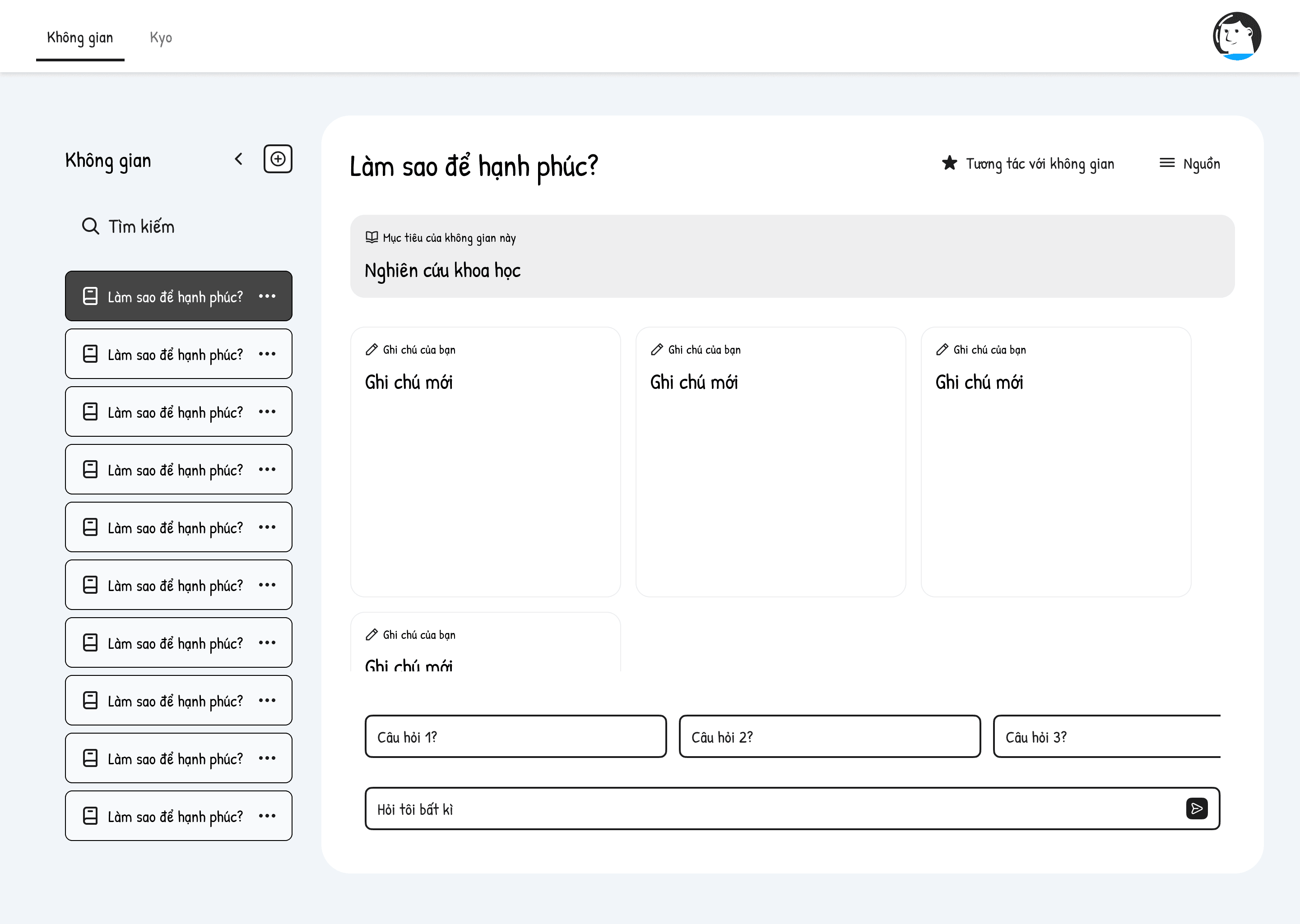
02
Access Directly to Current Workspace
Each conversation acts as a workspace — familiar, like ChatGPT.
Pro
Familiar experience. Easy to use out of the box.
Cons
Lacks clear learning pathways. AI guidance is weaker.
Chosen
03
Universal Homepage with Workspaces + AI Marketplace
Users set a goal at the start. AI adapts the experience accordingly, keeping sessions focused and structured.
Pro
Keeps users focused. Enables structured learning.
Cons
Best balance between structure and exploration, but harder to design well.


Yes we did some various options to get to design :)
Let's get to design!
We call it, the @ # ★ - syntax system.
Option 3 needed three things to work: file context, model control, and structured prompting. We could have built three separate menus.
What is it?
But we asked, what if all three lived in one place users already know? The input bar.
Developers use @, #, and shortcuts every day in Slack, Notion, GitHub. We borrowed the pattern. Cool right?
type #
to call out the file you want, ask directly.
type @
to call out the AI Models you need, make them compare their response.
turn on the prompting.
Solution 01
Every session starts
from zero

Solution 02
Users
can't

Solution 03
Nobody
knows how to prompt well

Save for later
The Prompt Helper was designed but not shipped. We made a deliberate call — ship the ★ starter cards and follow-up chips now, Prompt Helper in phase two once we had real user behavior data, due to time constraints and the need to validate the core market.
In hindsight, it was not a good decision — we should have found a way to ship a simpler version sooner.
New components



What the signal unlocked
The Prompt Helper — designed, not shipped
600+ sign-ups and 10+ B2B deals in 3 weeks answered the market question. However, the most direct gap from research was still unresolved, users couldn't write good prompts. The follow-up chips helped. But a more direct solution was possible.
So, I've designed 2 approaches


Some thoughtful learnings
What this project taught me.
Prioritization is everything
With limited time, I had to focus on the most impactful features first.
Agility & quick decision-making matter
Iterating rapidly kept the team moving forward.
User-centered design is key
Deeply understanding user pain points led to a product that resonated.
KyoAI closed due to the company's internal circumstances .
However, the experiment answered the question it was built to answer.
